Submitting Disney Lorcana cards to third-party grading services like PSA, BGS, or CGC requires a systematic pre-screening process. Ravensburger’s proprietary card stock, factory coating, and distinct dark card backs present specific vulnerabilities that do not always mirror older trading card games.
Catching factory defects, corner fraying, and surface imperfections before shipping can save substantial grading fees and prevent sub-gem disappointment.
Edge Integrity and Back Borders
The most unforgiving element of any Disney Lorcana card is its reverse side. Lorcana cards feature a deep midnight-blue and gold back border. Because dark ink sits over white card stock, any rough cut or compression exposes bright white core paper.
- Inspect all four reverse edges under an angled desk lamp. Look for edge chipping, which often occurs during the factory slitting process.
- Check top and bottom edges for burrs. First-wave printings of early sets occasionally show small fibrous tufts where dull cutting dies pulled rather than sliced the paper core.
- Examine each corner point closely. Lorcana corners are cut at a tight radius; any dull punch results in corner flaking that drops edge subgrades instantly.
The deep midnight-blue card back leaves zero room for error; even microscopic edge flaking appears as high-contrast white paper loss under magnification.
Surface Layer and Foil Anomalies
Surface inspection requires clean lighting and magnification. Non-foil cards, standard cold foils, and Enchanted alternate-art cards each possess distinct manufacturing quirks.
Standard foil cards in Lorcana utilize a cold-foil application that lays relatively flat but is susceptible to vertical print lines and roller tracks. Hold the card at a 45-degree angle beneath a single light source and tilt it slowly from top to bottom. Watch for breaks in the foil sheen, which signal roller indentations or pinhole voids in the foil layer.
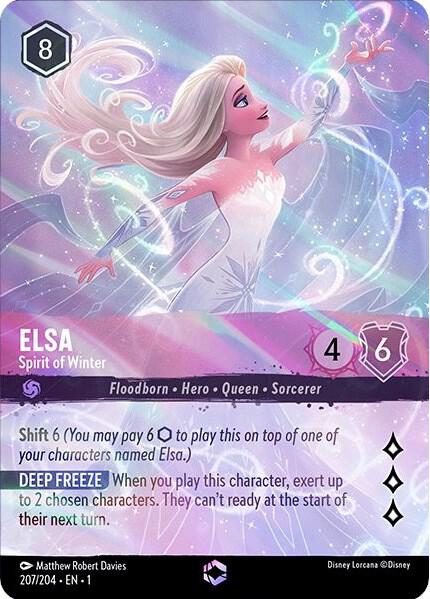
Enchanted cards require extra scrutiny across their full-art surface. Inspect the foil background around the character line art for silvering, micro-scratches, or ink pooling. Factory wax or roller grease can occasionally leave faint streaks across the protective gloss; if present, a gentle wipe with an untreated, clean microfiber cloth can clear foreign residue without abrading the surface.
Evaluating Centering
Lorcana cards carry distinct decorative frames on the front and a symmetrical circular emblem on the back. Both need careful measurement.
On the front, measure the distance from the outer edge of the colored art frame to the card's physical edge on both sides, then top and bottom. Standard Lorcana cards have thicker borders than Japanese card games, making minor centering shifts easier to detect with the naked eye.
On the back, use the circular Lorcana lore symbol as your anchor. The distance from the outer gold ring to the outer blue edge should remain consistent on left and right borders. If the back centering exceeds 65/35, obtaining a pristine top-tier grade becomes statistically improbable at major grading services.
Final Pre-Submission Routine
Always sleeve cards in clean, standard-gauge penny sleeves before inserting them into semi-rigid card savers. Avoid tight-fitting inner sleeves during grading submissions, as pushing a thick-stock Lorcana card into a rigid inner sleeve risks creasing the top border or dulling the bottom corners. Inspecting systematically ensures only true gem-mint candidates enter the grading queue.