
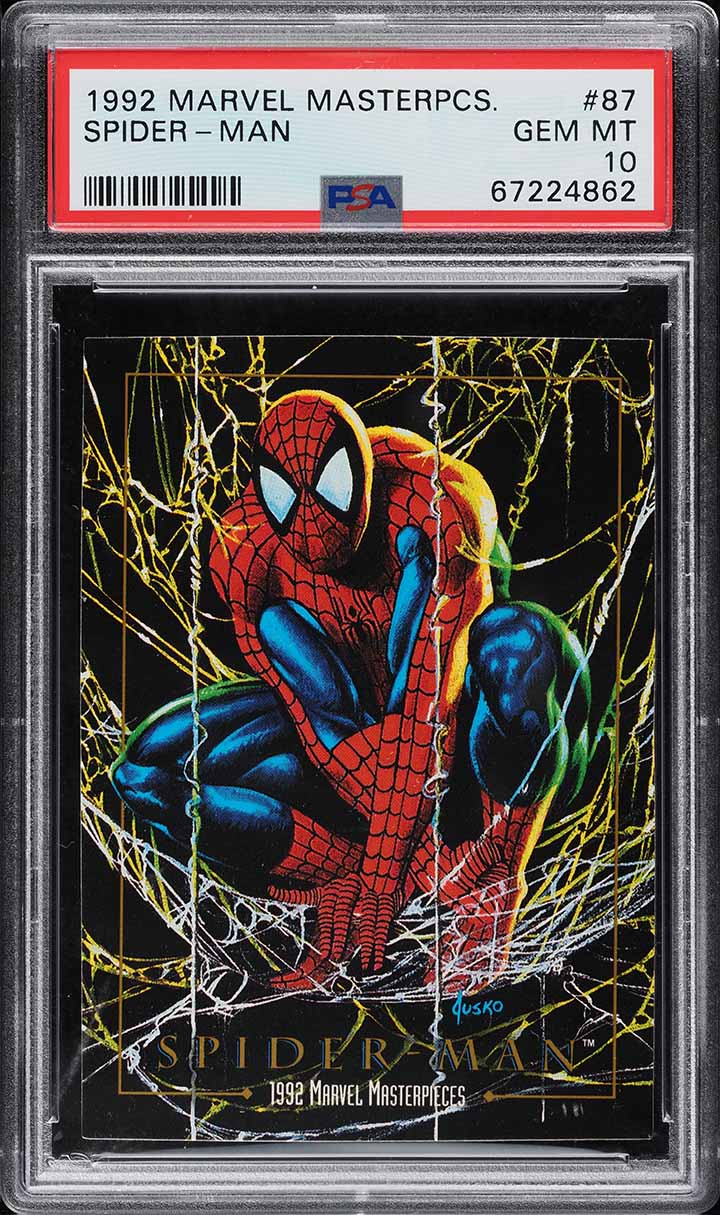
Evaluating comparable sales in non-sports cards requires a different framework than tracking sports or gaming singles. In trading card games, card utility and strict print tiers establish predictable price bands. In sports, on-field performance drives liquid volume across standardized rookie cards.
Marvel trading cards rarely behave like either category. A modern Marvel checklist contains parallel tiers numbered down to single digits, original one-of-one sketch cards, and legacy 1990s inserts where condition sensitivity heavily distorts high-grade valuations. Without a methodical approach to reading sales data, buyers frequently overpay based on misleading benchmarks.
The Distortion of the Character Hierarchy
Unlike traditional sets where uniform card numbering suggests uniform demand, Marvel secondary pricing is strictly dictated by character tiers. An emerald or ruby parallel numbered to ten copies does not carry a baseline price across the set.
Tier-one mainstays—primarily Spider-Man, Wolverine, Magneto, and Venom—command multiples over mid-tier heroes and minor villains from the same parallel sheet. A common error among new buyers is applying a recent sale of a tier-three character to an unpriced tier-two card, or assuming a rising price floor applies to the entire set checklist. When researching comparable sales, only compare cards featuring the same specific character or immediate peer in character tiering.
In non-sports card markets, a serial number only sets the scarcity; the character on the front dictates whether liquidity actually exists.
Sketch Cards: Why '1/1' Is Not a Price Anchor
Original art sketch cards represent one of the most volatile segments of the Marvel hobby. Every sketch card carries an implied one-of-one status, but treating them as interchangeable leads to bad acquisitions.
When evaluating a sketch card listing, aggregate past sales by the specific artist, not merely by the set or character. Well-known sketch illustrators who produce fully painted, dynamic portraits command substantial premiums over artists delivering quick, black-and-white line work. A buyer anchoring an offer to the lowest recent sketch sale of Iron Man will fail to understand why a detailed painted piece costs ten times more—and vice versa.
Filtering Stale and Masked Data
Because Marvel cards trade with lower volume than primary sports releases, secondary comps quickly go stale. A recorded transaction from six months prior may reflect an entirely different collector cycle, particularly around major film releases or set launches.
- Look past active asking prices: Sellers often list low-numbered inserts with aspirational buy-it-now figures that sit unsold for months. These are inventory placeholders, not market valuations.
- Account for accepted best offers: Many public marketplace databases record the initial listing price rather than the negotiated strike price. Always cross-reference against tools that display true accepted offer values.
- Verify the manufacturer and release: Upper Deck, Fleer Retro, and Topps Chrome each handle parallel naming differently. Confusing a base refractor parallel with a short-printed color match or hobby-exclusive variant is a frequent source of bad comps.
The Buy-Side Checklist
Before executing a high-value purchase on a raw or graded Marvel single, verify three baseline criteria:
- Compare identical grading outcomes: In vintage 1990s Marvel sets, high edge-chipping rates mean the gap between a Gem Mint copy and a Near-Mint copy is exponential. A sale of a grade nine copy cannot justify a speculative price on a raw card.
- Confirm the serial distribution: Check whether the card is a standard serial-numbered run or a retail-exclusive unnumbered parallel with unknown print runs.
- Match the pose and costume: Classic comic-book iterations consistently trade at premiums over cinematic universe stills or non-canonical redesigns.
Taking time to filter out non-identical character tiers, unverified best offers, and artist mismatches protects your capital and keeps your collection grounded in real market value.


