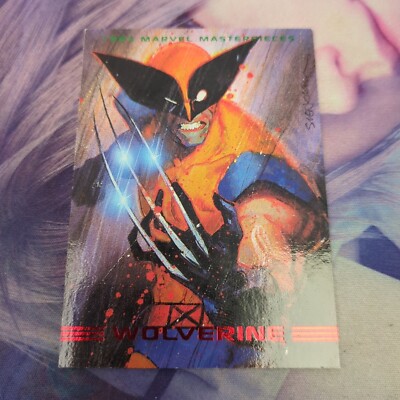
In 1992, comic cards underwent a structural shift. Prior to that year, sets like the 1990 and 1991 Impel Marvel Universe releases relied on traditional comic book line art: penciling, inking, and mechanical color separations. SkyBox aimed higher for a new premium line, tapping veteran illustrator Joe Jusko to paint an entire standalone release: 1992 Marvel Masterpieces.
It was the first fully painted mainstream comic card set ever produced. Jusko was tasked with illustrating 104 base cards, alongside several promotional cards and packaging art. The assignment required dozens of finished acrylic and gouache paintings delivered on an unforgiving production schedule.
To deliver more than a hundred fully rendered character portraits within months, Jusko relied on classical illustration techniques. Rather than drawing purely from imagination, he required precise anatomical reference for dynamic foreshortening, muscle tension, and dramatic light sources.
Studio Props and Self-Reference
Hiring professional models for over a hundred distinct character concepts was neither practical nor fast enough. Instead, Jusko turned his studio into a photography staging area, frequently serving as his own reference model.
Working with a camera, tripod, and a studio mirror, Jusko staged poses in his workout clothes. For characters wielding weapons, he used household objects. A broom handle stood in for a staff or the rim of Captain America’s shield. Clenched fists mimicked Wolverine’s unsheathed adamantium claws. Intense facial grimaces captured in reference photos translated directly onto the faces of characters like the Punisher and Sabretooth.
For female characters, Jusko enlisted his wife and friends to pose, ensuring consistent anatomy, fabric draping, and realistic weight distribution across the entire checklist.
Jusko tackled the immense workload by turning his studio into a photography staging area, often serving as his own anatomy reference for Marvel's fiercest heroes.
Redefining Superhero Realism
The resulting artwork gave 1992 Marvel Masterpieces a tactile, physical presence that comic card collectors had never encountered before. Up to that point, superhero anatomy on cardboard was stylized by penciled crosshatching and flat offset printing.
Jusko brought the tradition of classic pulp fantasy art—reminiscent of Frank Frazetta—to characters created by Stan Lee, Jack Kirby, and Steve Ditko. Cards like Spider-Man (#87), Wolverine (#93), and Hulk (#39) emphasized muscle striations, skin tones, fabric creases, and directional shadows.
When Spider-Man crouched on a rain-slicked gargoyle or Wolverine lunged forward with bared teeth, the underlying posture reflected real human mechanics grounded in Jusko’s photographic studies. Even characters like Venom and the Silver Surfer retained a sense of skeletal and muscular plausibility under their alien surfaces.
The Benchmark for 1990s Trading Cards
The 1992 release became an immediate commercial success and established painted trading cards as a dominant category throughout the 1990s. Its critical and retail reception led SkyBox to continue the Masterpieces line in subsequent years, handing duties to the Hildebrandt brothers in 1994 and Peter Scanlan in 1995.
Jusko eventually returned to Marvel Masterpieces decades later for the 2016 set, once again painting the base set solo. Yet the 1992 original remains the definitive moment when painted realism arrived on trading card stock. The cardboard portraits that defined an era began not just with brushstrokes, but with an illustrator posing in front of a studio camera holding a broom.