When Wizards of the Coast prepared the original Pokémon Base Set for its English release in early 1999, production teams worked under tight deadlines to localize hundreds of cards. Translators, graphic designers, and prepress operators had to adapt Japanese assets created years earlier by Media Factory and Creatures Inc.
That rush led directly to one of the most famous production variations in trading card history: the "Red Cheeks" Pikachu.
The Anime Disconnect
When Mitsuhiro Arita painted the original artwork for Pikachu in the 1996 Japanese Expansion Pack, the Pokémon animated series did not exist. The character design came directly from Game Boy sprites and early concept art by Ken Sugimori and Atsuko Nishida.
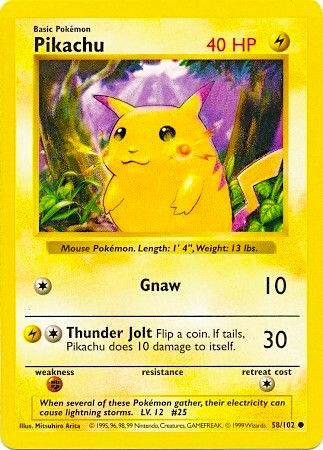
Arita painted Pikachu crouching in a forest clearing, crackling with electrical energy. Rather than painting distinct red circles on the character's face, Arita highlighted the cheek pouches in bright yellow to emphasize the glow of an electrical charge discharging from its body.
By late 1998, however, the Pokémon anime had launched in North America and quickly became a cultural phenomenon. To English audiences and American production staff, Pikachu was recognizable by two prominent physical traits: a lightning bolt tail and solid red circular cheek pouches.
A Unilateral Art Change
During prepress review at Wizards of the Coast, staff members noticed that card number 58 featured a Pikachu with yellow cheeks. Assuming the Japanese asset was incomplete or incorrectly colored relative to the brand's primary marketing assets, production personnel took matters into their own hands.
Wizards of the Coast digitally altered Arita's artwork, placing red circles onto Pikachu's cheeks to match the televised appearance.
"Someone at Wizards of the Coast assumed the yellow cheeks were an error and altered the file before the first print run began."
This modification was made without consulting the original artist or Creatures Inc. The altered art was submitted directly to the printing plates for the initial English print run.
The Correction
The red-cheeked version made it through the entire initial 1st Edition print run and into early Shadowless booster packs. Once Japanese stakeholders and Arita reviewed the localized product, the unauthorized change was caught.
Arita confirmed that the yellow cheeks were an intentional artistic choice designed to portray lighting and electrical energy, not an oversight. Wizards of the Coast updated the digital files, reverting Pikachu's cheeks back to Arita's original yellow artwork.
By the time Wizards transitioned from Shadowless printing plates to the standard Unlimited print run, the correction was permanent. All subsequent Unlimited Base Set packs contained exclusively Yellow Cheeks copies.
Surviving Variants
The resulting printing anomaly created two distinct categories for vintage collectors:
- Red Cheeks copies: Found across the majority of 1st Edition English Base Set packs and early Shadowless printings, as well as select E3 promotional distributions.
- Yellow Cheeks copies: Found on later Shadowless printings and across the entirety of the mass-market Unlimited Base Set run.
What began as a prepress misunderstanding remains a defining case study in early card localization, leaving behind a permanent record of the transition between the original video game designs and the global multimedia franchise that followed.