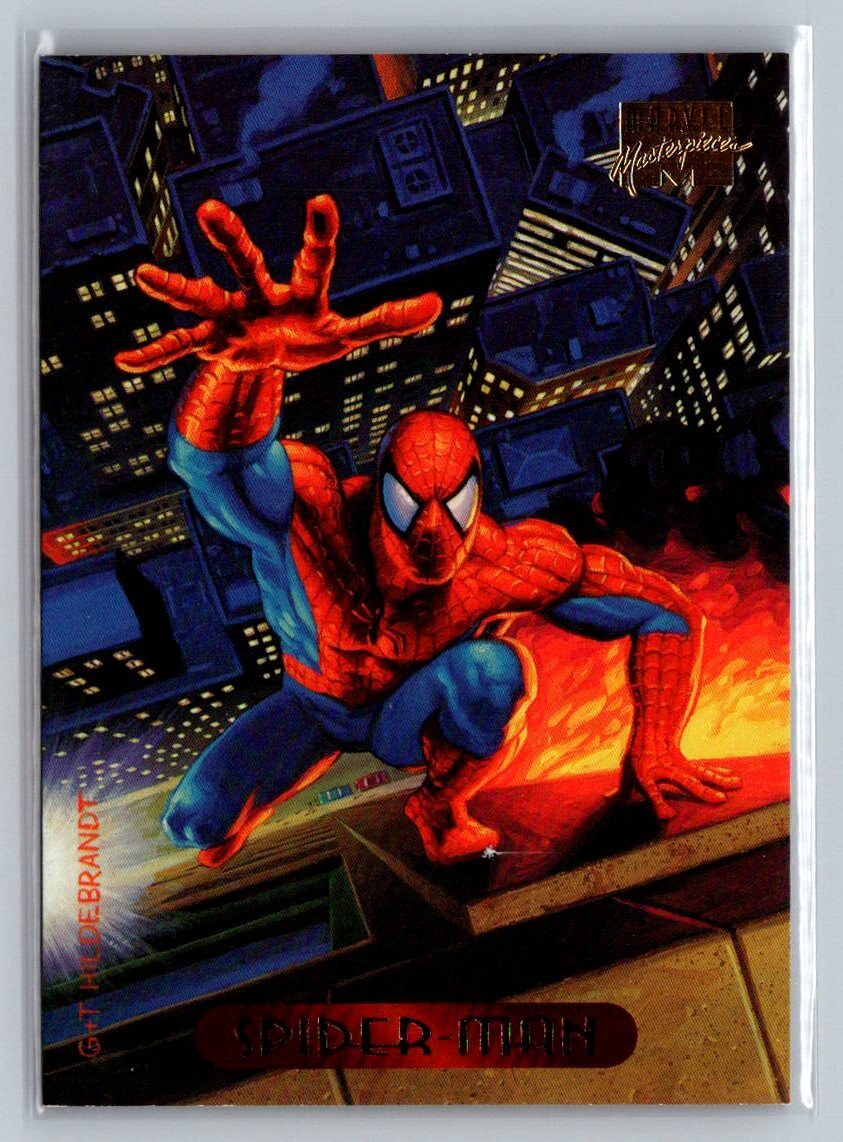
In the early 1990s, fully painted trading card sets transformed the hobby. Following the critical success of Joe Jusko's 100-card solo effort for 1992 Marvel Masterpieces, publisher Fleer wanted to maintain that visual standard for its 1994 release. The task required a massive output of original fine art on an aggressive commercial deadline. Fleer turned to twin brothers Greg and Tim Hildebrandt, already legendary in fantasy art for their 1970s Lord of the Rings calendars and original Star Wars movie poster.
What followed was one of the most unusual collaborative production processes in trading card history. Rather than dividing the set list by character, the brothers co-painted every single card together in their studio.
Two Easels and a Six-Month Deadline
Fleer commissioned the Hildebrandt brothers to produce the entire set, which ultimately required over 150 individual acrylic paintings to cover the 140 base cards, insert sets, and promotional material. The deadline gave them less than six months to complete the entire body of work.
To hit the schedule, the brothers established an assembly system inside their shared studio space. They set up easels opposite one another and developed a fluid handoff routine for every canvas:
- One brother would sketch the initial composition and lay down the preliminary underpainting.
- The canvas was passed across the room so the second brother could apply mid-tones, build up muscle structure, or flesh out environmental backgrounds.
- The artwork moved back and forth multiple times until final highlights, rim lighting, and detail work were complete.
"We didn't divide up the cards," Greg Hildebrandt recalled in later retrospectives on the project. "We worked on every single painting together. One of us would work on a background, pass it over, and the other would paint the figure."
Because both artists shared an identical technical foundation and painted with acrylics, their individual brushstrokes blended seamlessly. Collectors opening packs in 1994 were looking at unified artworks created by four hands rather than two.
Technical Execution Under Pressure
The 1994 Marvel Masterpieces set stands out for its dramatic theatrical lighting, heavy use of rich primaries, and dense muscular rendering. To keep production moving without sacrificing depth, the Hildebrandt brothers relied on real-life photo references, posing themselves and studio assistants to capture realistic anatomical tension for characters like Wolverine, Cyclops, and Spider-Man.
The set was released in late 1994 and featured several distinct production elements:
- A 140-card base set printed on heavy premium stock with gold foil stamping.
- 10 Power Blast inserts featuring metallic foil enhancements.
- 9 Holofoil cards utilizing 3D render technology layered over original art backgrounds.
- 4 Signature Series bronze foil parallel cards distributed in limited chase insertion rates.
The Lasting Impact of the 1994 Set
The project remains a benchmark for single-artist trading card sets. Completing more than 150 detailed acrylic paintings in under half a year pushed commercial illustration boundaries, demonstrating that full art sets could be produced at scale without sacrificing figurative technique.
For vintage Marvel collectors, 1994 Marvel Masterpieces remains a staple of the era. The seamless blending of two distinct artistic careers onto a single 2.5-by-3.5-inch canvas remains one of the most impressive production feats in non-sports card history.